Introduction
Amethyst is one of the world's most admired and recognizable gemstones, celebrated for its captivating shades of purple and its timeless elegance. A member of the quartz family, Amethyst has been treasured for thousands of years by civilizations across the globe. From royal crowns and ceremonial jewelry to modern home décor and crystal collections, this remarkable gemstone continues to inspire collectors, designers, and enthusiasts alike.
Its rich violet hues, exceptional durability, and widespread availability make it a popular choice for jewelry, decorative pieces, meditation spaces, and gemstone collections. Whether admired for its natural beauty or appreciated for the traditional cultural beliefs associated with it, Amethyst remains one of the most sought-after gemstones in the world.
This comprehensive guide explores everything you need to know about Amethyst, including its geological formation, history, physical properties, varieties, traditional symbolism, uses, care instructions, and practical tips for choosing a genuine stone.
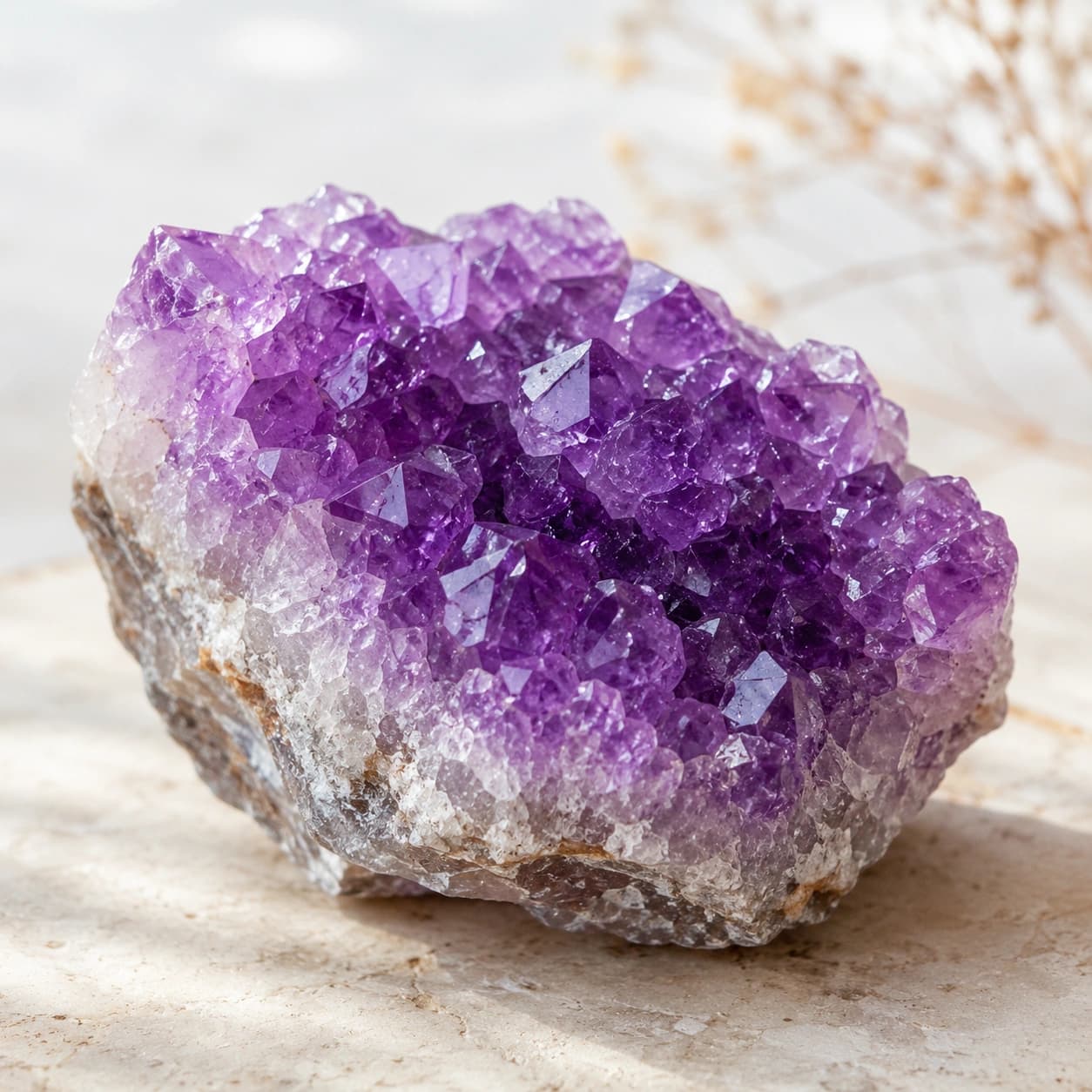
What Is Amethyst?Amethyst is a naturally occurring purple variety of quartz (silicon dioxide). The gemstone owes its distinctive color to trace amounts of iron within its crystal structure, combined with natural radiation over millions of years during its formation beneath the Earth's surface.
The color of Amethyst ranges from soft lavender and lilac to deep violet and rich royal purple. Each crystal develops unique color zoning, inclusions, and natural patterns that contribute to its individual beauty and character.
Amethyst is valued for both its aesthetic appeal and its versatility. It is commonly fashioned into rings, pendants, bracelets, earrings, decorative carvings, crystal clusters, geodes, spheres, pyramids, and home décor items.
History of AmethystAmethyst has a rich history that spans thousands of years. Ancient civilizations regarded it as one of the most precious gemstones available.
The name "Amethyst" originates from the ancient Greek word amethystos, meaning "not intoxicated." According to Greek mythology, people believed the gemstone could help maintain mental clarity and prevent intoxication, leading many to carve drinking vessels from Amethyst.
Throughout history, Amethyst symbolized royalty, wisdom, dignity, and spiritual devotion. Kings, queens, religious leaders, and nobility frequently adorned themselves with Amethyst jewelry, crowns, and ceremonial ornaments.
During the Middle Ages, the gemstone became closely associated with faith, humility, and sincerity. It was commonly featured in religious jewelry and ecclesiastical artifacts.
Today, Amethyst continues to be cherished worldwide for its timeless elegance and enduring popularity.
Geological Formation of AmethystAmethyst forms naturally within volcanic rocks and geodes over millions of years.
The formation process begins when silica-rich groundwater fills cavities within volcanic rock. As temperatures gradually decrease, quartz crystals begin to grow along the cavity walls.
Trace amounts of iron become incorporated into the crystal lattice during growth. Natural radiation from surrounding rocks then alters the iron atoms, creating the gemstone's characteristic purple coloration.
Each crystal develops slowly under unique geological conditions, resulting in distinct color variations, crystal sizes, and internal formations.
Large Amethyst geodes containing thousands of sparkling crystals are among nature's most spectacular mineral formations.
Physical Properties of AmethystPropertyDetailsMineral FamilyQuartzChemical FormulaSiO₂ (Silicon Dioxide)Crystal SystemTrigonalHardness7 on the Mohs ScaleSpecific Gravity2.65TransparencyTransparent to TranslucentLusterVitreous (Glass-like)CleavageNoneFractureConchoidalColorLight Purple to Deep VioletIts hardness makes Amethyst suitable for everyday jewelry when handled with reasonable care.
Color VariationsNatural Amethyst occurs in a beautiful range of purple shades, including:
- Pale Lavender
- Light Lilac
- Soft Violet
- Medium Purple
- Deep Purple
- Royal Purple
- Reddish Purple
- Bluish Violet
Some stones display multiple shades within the same crystal due to natural color zoning. These variations make every Amethyst unique.
Generally, gemstones exhibiting rich, evenly distributed purple coloration with excellent transparency are considered especially desirable.
Major Sources of AmethystAmethyst is found in many regions around the world. Some of the most significant sources include:
- Brazil
- Uruguay
- Zambia
- Bolivia
- Madagascar
- Russia
- India
- South Korea
- Mexico
- Canada
- United States
Brazil produces some of the largest Amethyst geodes, while Uruguay is particularly renowned for deep, richly colored crystals with exceptional brilliance.
Zambian Amethyst is often appreciated for its intense violet color and excellent clarity.
Types of AmethystSeveral varieties of Amethyst are available, each possessing its own distinctive appearance.
Deep Purple Amethyst
Known for its rich royal purple color and premium appearance.
Lavender Amethyst
Features softer pastel shades with elegant translucency.
Chevron Amethyst
Displays natural V-shaped bands of white quartz and purple Amethyst.
Brandberg Amethyst
Originating from Namibia, this rare variety often combines Amethyst with Clear Quartz and Smoky Quartz.
Siberian Amethyst
Historically associated with exceptionally rich purple coloration featuring flashes of red and blue under light.
Amethyst Geodes
Large hollow rock formations lined with sparkling Amethyst crystals, commonly used for interior decoration and mineral collections.
Symbolism of AmethystAcross many cultures, Amethyst has traditionally symbolized:
- Wisdom
- Peace
- Inner balance
- Clarity of thought
- Sincerity
- Humility
- Courage
- Spiritual awareness
- Protection
- Harmony
These symbolic associations are rooted in cultural traditions and historical beliefs rather than scientific evidence.
Traditional Benefits of AmethystFor centuries, Amethyst has been associated in various traditions with:
- Encouraging emotional balance
- Supporting relaxation
- Promoting mental clarity
- Inspiring creativity
- Enhancing focus during meditation
- Encouraging self-reflection
- Creating a peaceful atmosphere
- Supporting spiritual practices
- Fostering positive intentions
- Symbolizing wisdom and tranquility
Disclaimer: These traditional beliefs are based on cultural, historical, and spiritual practices. They are not scientifically proven and should not replace professional medical, psychological, or therapeutic advice.